
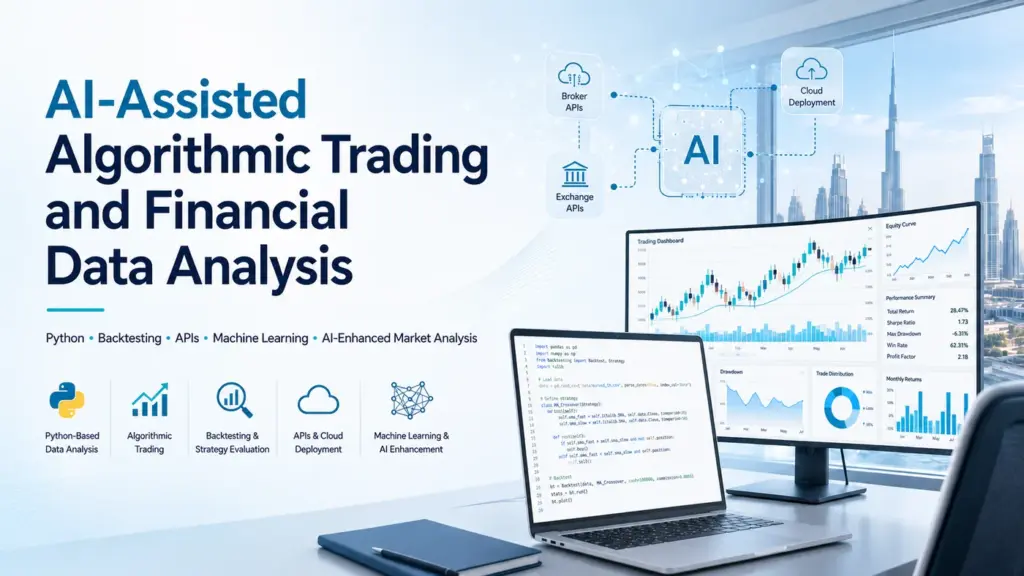
AI-Assisted Algorithmic Trading and Financial Data Analysis
From data collection to live deployment. Learn how to design, backtest, and automate trading strategies — and how AI is changing the way professionals analyse financial markets.
Most traders and finance professionals still rely on manual processes — checking charts, copying data into spreadsheets, executing orders by hand. Algorithmic trading changes that. A well-designed system can scan markets, test hypotheses, and execute strategies consistently and without emotion.
This programme teaches you how to build those systems using Python — from collecting and cleaning financial data, to defining and backtesting strategies, to connecting to broker and exchange APIs and deploying in a cloud environment.
As of 2026, AI is also changing how market professionals work. This programme introduces practical machine learning for financial markets and AI-enhanced analysis techniques — so participants leave with a modern, complete picture of the field.
Apply for the programmeQuick facts
Prerequisites
What you will be able to do after this programme
Curriculum — 10 modules · 15 hours of live instruction
- Python environment for financial data work
- Key libraries: pandas, numpy, matplotlib, requests, ccxt
- Jupyter notebooks and cloud notebook environments
- Connecting to data sources and APIs
- Market data sources: price, volume, OHLCV from exchanges and brokers
- Alternative data sources: news feeds, earnings call transcripts, social media signals
- Scraping and collecting data from web sources and APIs
- Handling missing data, time zones, and data quality
- Building a clean, structured financial dataset ready for analysis and modelling
- Exploratory analysis of price and volume data
- Technical indicators: moving averages, RSI, Bollinger Bands, MACD
- Returns, volatility, and correlation analysis
- Using AI tools to surface patterns and anomalies that are difficult to detect manually
- Visualising market data for insight and presentation
- Connecting to broker and crypto exchange APIs using Python
- Authenticating, placing orders, and retrieving account data
- Rate limits, error handling, and safe API usage
- Paper trading and sandbox environments for testing
- Types of trading strategies: trend-following, mean reversion, momentum
- Translating a trading idea into a systematic rule set
- Using AI tools to generate, screen, and refine strategy hypotheses from market data
- Entry and exit conditions, position sizing, and risk management
- Common mistakes in strategy design — and how AI can help and hurt
- Building a backtesting framework in Python
- Evaluating strategy performance: returns, drawdown, Sharpe ratio
- Overfitting, look-ahead bias, survivorship bias, and data leakage
- Forward testing and walk-forward validation
- Using AI to evaluate parameter sensitivity and stress-test strategy assumptions
- Why cloud deployment matters for trading systems
- Setting up a cloud server for continuous operation
- Scheduling, logging, and monitoring your system
- Managing credentials and API keys securely
- Deploying your strategy to a live cloud environment
- Real-time data feeds and order execution
- AI-assisted performance monitoring and anomaly detection in live systems
- Handling failures gracefully and moving from paper trading to live operation safely
- Human oversight: what AI should decide and what requires human judgment
- Where machine learning adds genuine value in trading — and where it does not
- Supervised learning for price direction and signal classification
- Feature engineering from market data and alternative data sources
- Gradient boosting and ensemble methods used by professional quant firms
- Evaluating ML model performance in a financial context
- How professional trading desks and quant funds are using AI in 2026
- Financial LLMs (FinBERT) for sentiment analysis from news, earnings calls, and social media
- Using large language models to process unstructured financial information at scale
- AI for idea generation and research — humans accountable for risk and execution
- Practical limitations, explainability, and governance in AI-assisted trading
- Building a responsible AI-assisted trading workflow from research to live deployment
Who this programme is for
Your instructor

Your learning path
Alumni of the AI-Assisted Cryptocurrency Trading programme receive priority enrolment. Each programme builds directly on the previous.
Upcoming cohorts
Programme fee
- 15 hours of live instruction across 6 sessions
- Hands-on implementation in every session — real data, real APIs, real systems
- Cloud environment guidance for strategy deployment
- Innosoft Gulf certificate of completion
- KHDA attestation available on request
- Priority enrolment for the next programme in the learning path
Seats limited to 12 per cohort · Corporate group bookings of 4 or more receive a custom schedule and preferential pricing — contact info@innosoftgulf.com or WhatsApp +971 52 351 7403
Frequently asked questions
This programme is intended for educational and market analysis purposes only. It does not constitute financial advice and does not guarantee trading results. Algorithmic trading and financial markets carry significant risk of loss.
